

 HOME
HOME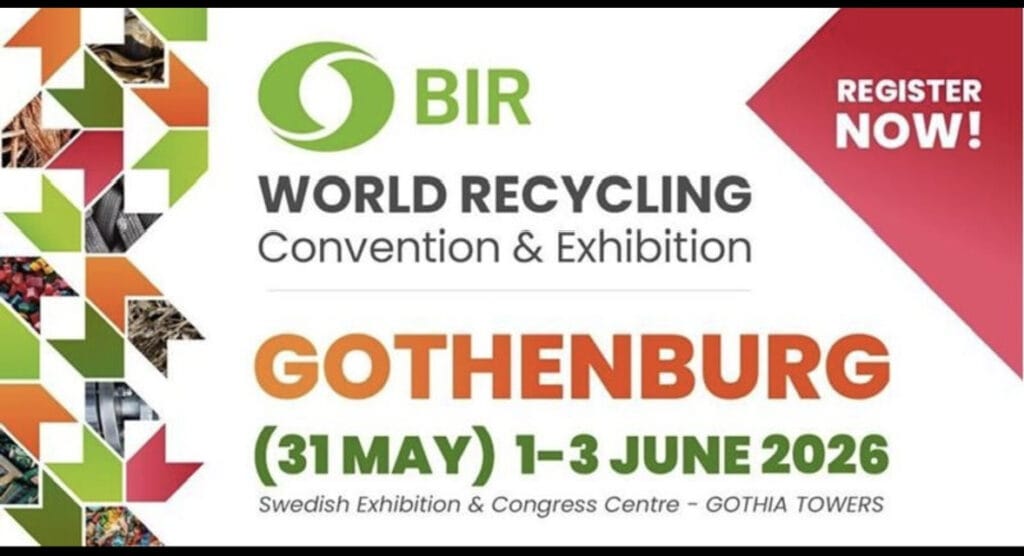
BIR GOTHENBURG 2026:
Global Recycling Trade Stands at a Historical Turning Point
Live broadcast from BIR World Recycling Convention & Exhibition 2026 (Gothenburg, Sweden). The BIR World Recycling Convention & Exhibition 2026, held for the first time in the city of Gothenburg (Sweden), brings together more than 2,000 delegates from across the globe for three days of intense discussions on recycling trade, carbon policies, strategic minerals, and the future of the aluminum scrap industry. The event takes place precisely at a time when the world metal market is facing double pressure from Guinea and the Middle East.
Convention Highlights
International Trade Council Session: Supply Chain Disruptions Dominate
The most important session of the pre-convention (May 19), chaired by Emmanuel Katrakis, focused on the theme: escalating geopolitical tensions, shifting economic alliances, and increasingly stringent regulatory frameworks that are reshaping the entire international trade flow of recycled materials.
- Fernando Acosta – Economic Outlook Analysis: Presented on the changing copper recycling rates and the growing strategic importance of secondary copper in meeting global industrial demand. Emphasized the role of recycled copper in enhancing resource efficiency and strengthening the supply chain.
- Robin Wiener – The Importance of International Trade: Core thesis: effective cross-border trade is the foundation for strengthening domestic manufacturing supply chains and helping strategic downstream sectors maintain competitiveness amid market fragmentation.
- Mattias Rapaport – Corporate Strategy Adjustments: Outlined how major recycling corporations are restructuring their trade and operational strategies to adapt to changing global trade conditions and new regulatory barriers.
“As the global recycled materials market becomes increasingly fragmented, the question is no longer whether there will be disruptions – but rather which companies can build resilience fast enough to turn disruptions into opportunities.”— Summary from the BIR International Trade Council panel discussion (Gothenburg, 05/2026)
CBAM And Stainless Steel: Europe’s Game Replay
The Stainless Steel & Special Alloys Committee session at BIR Gothenburg (June 2) featured a prominent theme: “Redefining the stainless steel market – CBAM, India, and new smelting technologies.”
Julia Ettinger, Secretary General of Recycling Europe, presented on the current status of the Carbon Border Adjustment Mechanism (CBAM) and its direct implications for the recycling industry. CBAM officially enters its implementation phase on January 1, 2026, applying carbon tariffs to aluminum, steel, and downstream products imported into the EU. A shipment of 10,000 tons of primary aluminum from a high-emission country could face CBAM costs of up to $970,000 if default values are applied.
Of particular importance to the recycling industry: the EU has included pre-consumer aluminum scrap within the scope of CBAM as an independent product, while currently considering additional trade measures for aluminum scrap exported from the EU in Q2/2026. BIR has officially submitted its opposing position to the European Commission, arguing that some proposed measures run the risk of undermining the very recycling industry that these policies claim to want to protect.
EV Batteries & Strategic Minerals: The Role of Recycling Elevated
The E-Scrap & EV Batteries Committee at BIR Gothenburg focused on the theme: “Essential minerals, EV batteries, and the growing strategic role of recyclers.” The supportive policy background for this discussion is very robust: the EU has issued the RESourceEU plan worth 3 billion EUR to accelerate the domestic supply chain of critical minerals. From September 2026, waste lithium-ion batteries and black mass will be banned from export to non-OECD countries, creating a significant advantage for EU domestic recyclers. The recycling of rare earth waste can meet up to 20% of the EU’s permanent magnet demand.
Paper Committee Special Session: Freight Rate Volatility
The BIR Global Recycled Paper Market Report for May 2026 warns: freight rate volatility is currently the greatest threat to the profitability of the international paper recycling industry. Disruptions in the Strait of Hormuz – along with routing barriers across the Indian Ocean – are driving logistics costs to alarming levels.
Detailed Program By Day
Why Gothenburg? A Circular Economy Leader
This marks the first time the BIR World Recycling Convention has set foot in Sweden’s largest port city. Gothenburg was selected not only for its world-class convention infrastructure at the Swedish Exhibition & Congress Centre – Gothia Towers (the largest integrated convention center in Scandinavia), but also for its reputation as a leading city for sustainable innovation and circular economy in Europe – perfectly aligned with BIR’s mission.
Opening June 1: Keynote Fredrik Harén – “Creativity in Times of Uncertainty”
The convention opened on June 1 with a keynote address by Fredrik Harén – an internationally renowned speaker titled “The Creativity Explorer” – revolving around the theme: “Unlocking creativity and resourcefulness in times of change”. The core message: amid unprecedented global supply chain disruptions, the recycling industry needs to rethink its strategy rather than merely reacting to individual shocks. Harén emphasized that curiosity and adaptability are two non-replicable competitive advantages for recycling companies in an era of geopolitical chaos.
June 1 – Shredder Committee: Technology & Safety
The Shredder Committee session (15:00-16:00, June 1), chaired by Alton Scott Newell III (Newell Recycling Equipment, USA), featured key strategic presentations:
- World Shredder List 2026 – Alton Scott Newell III: A global overview of shredder infrastructure: capacity and trends by region – an essential benchmark reference for the industry.
- Fire Prevention Policy – George Adams, CEO of SA Recycling (USA): Presented the Fire Prevention Policy of the Recycled Materials Association (ReMA), prioritizing safety above all at every scrap yard.
June 2 – Textiles Session: Trade & Circular Economy
A special session of the BIR Textiles Division (9:00-14:00, June 2) brought together policymakers, industry representatives, researchers, and international organizations – focusing on the rapidly changing global landscape of textile reuse and recycling. The keynote address was delivered by Rodrigo – Senior Researcher at the World Trade Institute, University of Bern, and Legal Advisor at the Swiss Institute of Comparative Law. Theme: “Making trade work for circularity” (based on a joint UNECE-ECLAC study). He analyzed current systemic distortions – from the wave of ultra-fast fashion and declining product quality – to how international trade can serve circular economy goals instead of hindering them.
Environmental Council: ELV Regulation & Steel Standards
The BIR International Environmental Council in Gothenburg discussed the central theme: “From regulation to enforcement – The EU’s End-of-Life Vehicles (ELV) Regulation and steel standards.” This is an especially critical session as the EU tightens recycled content requirements in automotive production and establishes new green steel standards. The vehicle scrap recycling industry faces great opportunities but also encounters pressure to prove the origin and recycled content of materials as required by the new ELV Regulation – a traceability challenge that many businesses in the recycled steel supply chain are not yet ready for.
Ferrous Market: Tariffs And The BIR/KPMG Study
The BIR Ferrous Division confirmed that in 2026 it will publish a comprehensive BIR/KPMG study on the environmental benefits of recycling – updating the latest figures to reaffirm the essential role of recycled steel. As Prof. Dr. Frank Pothen (Jena University of Applied Sciences) presented in Valencia 2025: “Using recycled steel brings immense ecological benefits.” The hottest topic of this division: tariff disputes. Michael Gaylard, Global Ferrous Commercial Director at Sims Metal, analyzed the business challenges caused by tariffs, particularly the impossibility of mid-term business planning when tariff measures change continuously and unpredictably.
June 3 Update & Closing
The convention is entering its closing day with the EV Batteries & Critical Minerals session and the BIR General Assembly. The official summary report is expected to be released by BIR within 48-72 hours after conclusion. VMRF will update as soon as information becomes available.
Main Schedule: BIR Gothenburg 2026
| Date | Program Name / Venue | Detailed Content |
|---|---|---|
| Sun May 31 | Young Traders Evening Pam’s Pool Deck, Jacy’z Hotel | A special networking event for young traders (under 35), on a Gothenburg rooftop overlooking the entire city. Takes place at 20:00. |
| Mon June 1 | Official Opening BIR Welcome Evening | Opening of the convention, welcome reception for delegates. First plenary session. Midday networking activities. |
| Tue June 2 | Stainless Steel & CBAM Recycled Paper (Special Session 14:00-17:30) Textiles | CBAM & the EU recycling industry – Julia Ettinger (Recycling Europe). Indian stainless steel and new smelting techniques. Global textile regulations and circular economy. |
| Wed June 3 | EV Batteries & Critical Minerals Closing Plenary Session Liseberg Gala Evening | Strategic role of recyclers in the battery supply chain. Market round-up. Evening: party at Liseberg Park – the largest amusement park in Scandinavia. |
Convention Highlights (Updated June 3)
Day 3 Closing Open
EV Batteries Session & BIR General Assembly
Opening Keynote June 1
Fredrik Harén: “Creativity in times of change”
Important Declaration
BIR opposes EU aluminum scrap trade measures
Notable Program
Stainless Steel: CBAM, India & New Smelting Tech
EU Policy 2026
Export ban on black mass from September 2026
Market Context
Hormuz + Guinea = Double blow to supply
Next Convention
BIR moves Fall 2026 convention to Malaga, Spain
VMRF Perspective
BIR Gothenburg 2026 is not just a networking event – it is a true summit for the metal recycling industry in a pivotal year. Discussions on CBAM, EU aluminum scrap, and strategic minerals are directly shaping the regulatory framework within which Vietnamese recycling companies will have to operate in the coming years.
Related Posts
BIR Convention Gothenburg 2026
Weekly Market Bulletin: Aluminum & Raw Materials
Specialized Metal, Lightweight Materials, and Recycling Exhibition Series in Shanghai: ALUMINIUM – COPPER – AUTOMOTIVE LIGHTWEIGHT – MAGNESIUM – METAL RECYCLING CHINA 2026
THACO Proposes a US$4.4 Billion Bauxite–Alumina Mega Project in Lam Dong: Ambition to Control the Aluminum Value Chain and a New Turning Point for Vietnam’s Industrial Development
Vietnam’s First Aluminum Smelter Set to Begin Operations: The Final Piece in the Ambition to Build a National Aluminum Industry Value Chain
Global Non-Ferrous Metals Market Experiences Strong Volatility: Copper Remains the Center of Attention