

 HOME
HOME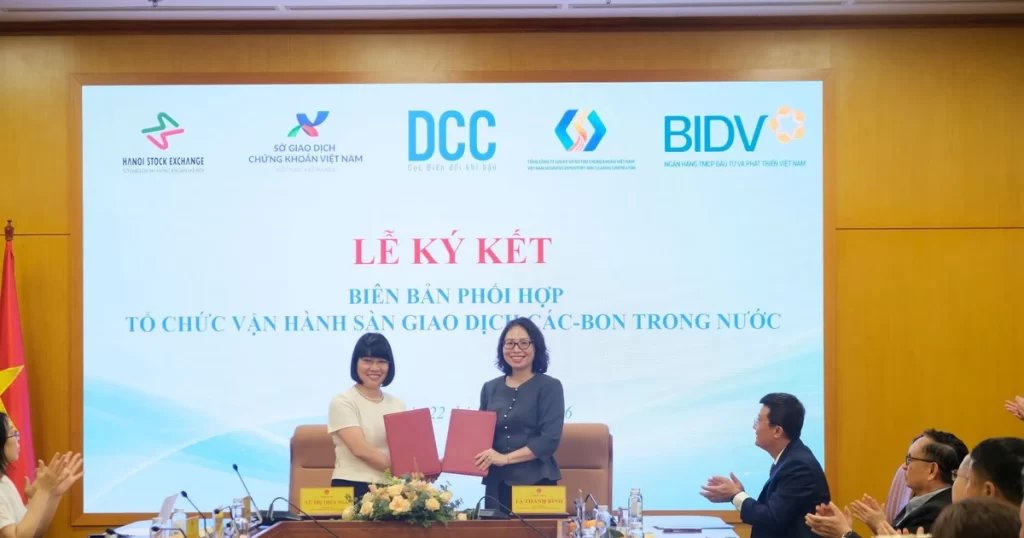
On June 22, 2026, the Ministry of Agriculture and Environment hosted a signing ceremony for a series of cooperation agreements aimed at organizing and operating Vietnam’s domestic carbon exchange. The event marks a significant milestone in the country’s efforts to establish a carbon market and advance its commitment to achieving net-zero greenhouse gas emissions by 2050.
The ceremony is widely regarded as more than a technical or administrative event. It represents a strategic step toward implementing the commitments Vietnam made at COP26 and signals the transition of the country’s carbon market from the regulatory development phase to practical implementation.
Completing the Final Building Blocks of Vietnam’s Carbon Market
Several key cooperation agreements were signed during the event, including:
- A cooperation agreement between the Ministry of Agriculture and Environment (represented by the Department of Climate Change), the Vietnam Exchange (VNX), the Vietnam Securities Depository and Clearing Corporation (VSDC), and the Hanoi Stock Exchange (HNX).
- A cooperation agreement between VNX and VSDC.
- A cooperation agreement between VSDC and HNX.
- A cooperation agreement between VSDC and the Joint Stock Commercial Bank for Investment and Development of Vietnam (BIDV).
The agreements establish mechanisms for information and data sharing, registration, custody, trading, settlement, reporting, market supervision, information disclosure, and incident management related to the operation of Vietnam’s carbon exchange.
According to financial market experts, leveraging the existing securities market infrastructure to support carbon trading is consistent with international best practices. Jurisdictions such as the European Union, South Korea, and China have adopted similar approaches, utilizing established financial market institutions to ensure transparency, efficiency, and regulatory oversight in emissions trading systems (ETS).
Decree 29/2026/ND-CP Provides the Legal Foundation
The signing ceremony took place following the issuance of Decree No. 29/2026/ND-CP on the domestic carbon exchange, the first comprehensive legal framework governing carbon market operations in Vietnam.
The decree outlines regulations covering the registration, issuance, custody, transfer, trading, and settlement of greenhouse gas emission allowances and eligible carbon credits. It also clearly defines the responsibilities of regulatory agencies and market infrastructure operators, with VNX, VSDC, and HNX serving as core institutions supporting the carbon market ecosystem.
Speaking at the event, Mr. Hoang Van Thu, Vice Chairman of the State Securities Commission of Vietnam (SSC), emphasized that under the direction of the Government, the Ministry of Finance and the Ministry of Agriculture and Environment have worked closely together to develop both the legal framework and the information technology infrastructure required for the operation of the carbon exchange.
He noted that the signing ceremony demonstrates strong coordination between government regulators and market operators and lays the groundwork for a transparent, secure, and efficient carbon trading platform.
From Net-Zero Commitments to a Practical Economic Instrument
Mr. Nguyen Tuan Quang, Acting Deputy Director General of the Department of Climate Change, stated that the Ministry of Agriculture and Environment has already issued regulations governing the National Registry System for greenhouse gas emission allowances and carbon credits.
Although carbon trading remains a relatively new concept in Vietnam, the experience of participating institutions in operating the securities market is expected to support the safe and effective operation of the carbon exchange while gradually aligning it with international standards.
Under the roadmap approved by the Government, Vietnam plans to pilot its carbon market from 2025 to 2028 before expanding to a fully operational nationwide system in subsequent years.
International Experts Recognize Vietnam’s Potential
According to the World Bank’s State and Trends of Carbon Pricing 2026 report, carbon pricing mechanisms currently cover nearly 30 percent of global greenhouse gas emissions and generated more than USD 107 billion in public revenues during 2025.
The report highlights a growing trend among emerging economies to develop carbon markets as a cost-effective tool for reducing emissions while supporting sustainable economic growth.
Experts from the International Carbon Action Partnership (ICAP) have identified Vietnam as one of Southeast Asia’s fastest-developing carbon markets. Vietnam’s emissions trading roadmap is considered systematic and pragmatic, initially focusing on major emitting sectors such as power generation, steel, and cement before gradually expanding to other industries.
Studies by the World Bank further suggest that carbon pricing instruments can help Vietnam achieve its climate commitments more efficiently while stimulating investment in clean technologies and low-carbon development.
New Opportunities for Vietnamese Businesses
The establishment of a domestic carbon exchange carries significant economic implications beyond environmental benefits.
Companies that invest early in energy efficiency, renewable energy, metal recycling, waste management, low-carbon agriculture, and carbon sequestration projects may generate carbon credits that can be traded on the market.
For export-oriented industries such as steel, cement, aluminum, chemicals, and electricity generation, participation in the carbon market will also help businesses prepare for international climate-related trade measures, including the European Union’s Carbon Border Adjustment Mechanism (CBAM).
Mr. Luong Quang Huy, one of Vietnam’s leading carbon market experts, has previously stated that carbon markets can become an important economic instrument for reducing emissions at lower costs than traditional administrative measures while creating new financial resources to support the green transition of Vietnamese enterprises.
Challenges Remain Ahead
Despite the progress achieved so far, both domestic and international experts agree that significant challenges remain.
These include strengthening greenhouse gas inventories, improving emissions data quality, developing a robust monitoring, reporting and verification (MRV) system, enhancing carbon credit verification capacity, ensuring market transparency, and increasing awareness among businesses about the economic value of carbon assets.
Experiences from the European Union, China, and South Korea demonstrate that new carbon markets often face initial challenges related to liquidity, data quality, and compliance capacity. However, when properly designed and implemented, carbon markets can become powerful drivers of technological innovation, industrial competitiveness, and green investment.
The signing ceremony on June 22, 2026, therefore represents far more than an administrative agreement among government agencies and market operators. It marks an important milestone in Vietnam’s journey toward establishing a modern, transparent, and internationally integrated carbon market, supporting the country’s broader objectives of green growth and net-zero emissions by 2050.
Sources: chinhphu.vn, vietstock.vn, and compiled from the internet.
Related Posts
LME Aluminum Prices Fall: Market Shifts from Supply Shortage Concerns to Expectations of Supply Recovery
WSR Update: Vietnam has not yet been recommended by the EC for approval regarding recycled metals.
VMRF – Circulate Capital: ESG from Compliance Requirements to Management Capability
VMRF and Kitakyushu City Explore Cooperation Opportunities in Recycling and Environmental Technology
Low River Levels in Borneo Expose New Weaknesses in Asia’s Energy Supply Chain
Green and Circular Projects May Receive 2% Interest Rate Support