

 HOME
HOME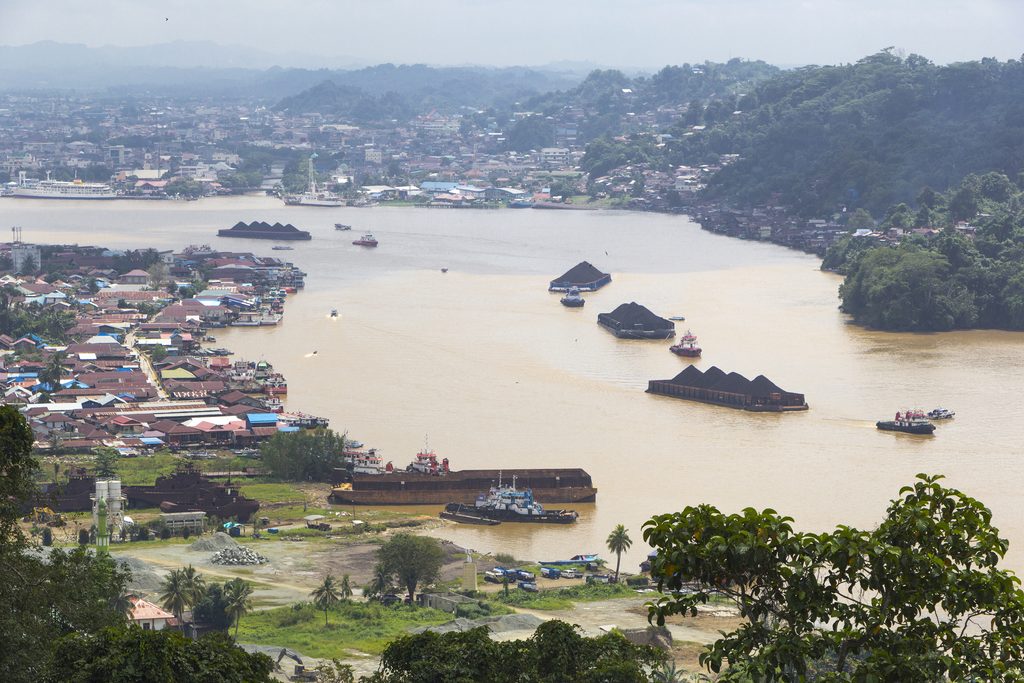
Falling water levels on several rivers in Kalimantan are disrupting barge transportation of coal and creating another logistics risk for Asia’s energy market. As industries across the region become increasingly dependent on stable electricity supplies, a problem that appears local could quickly become a wider variable for regional supply chains.
Indonesia is facing an increasingly important challenge in its coal supply chain. The issue is not a lack of resources underground, but the difficulty of moving coal from mines to export terminals.
In Kalimantan, where much of Indonesia’s coal production is concentrated, low water levels on several rivers have restricted barge operations. According to the Indonesian Coal Mining Association, when river levels fall, barges have to reduce their draft, preventing them from carrying full loads. The result is slower transportation, higher logistics costs and the potential accumulation of coal at mining areas and transshipment points.
An Indonesian employers’ association has estimated that restrictions on the Barito River alone could affect the transportation of around 3.9 million tonnes of coal per month. This does not mean that all of this volume will disappear from the market, but it illustrates the potential scale of the logistics bottleneck if difficult river conditions persist.
When a River Becomes a Supply Chain Bottleneck
Indonesia remains the world’s largest exporter of thermal coal. According to the International Energy Agency, the country exported around 517 million tonnes of thermal coal in 2025, while exports in 2026 are expected to decline due to several factors, including production policies and developments in international demand.
A significant share of coal transportation in Kalimantan depends on river systems before the cargo reaches seaports. This creates a vulnerability that power producers in importing countries may not immediately see when assessing supply security.
Low river levels do not necessarily eliminate the availability of coal. They can, however, reduce the speed at which the commodity moves through the supply chain. When barges have to operate below capacity, more trips are required to transport the same volume. If the situation continues, delivery times can increase, inventories at mines and ports can change, and buyers may have to consider alternative sources.
Gita Maharyani, executive director of the Indonesian Coal Mining Association, has said that logistics conditions in Indonesia can influence market sentiment but are not the only factor determining coal prices. Global supply and demand, along with other market conditions, continue to play a major role.
This distinction is important because the current situation is better understood as a supply-chain reliability risk rather than simply a coal price shock.
El Niño Adds Pressure to Indonesia’s River Systems
Weather conditions are adding another layer of uncertainty. Indonesia has experienced notable dry conditions in 2026, with the country’s Meteorology, Climatology and Geophysical Agency reporting below-normal rainfall in several areas and dry seasons that are lasting longer in some regions.
BMKG data also showed that a large share of Indonesia experienced low rainfall during parts of August, while many areas recorded precipitation below normal levels.
For mining and coal exports in Kalimantan, this is particularly significant because river transportation depends not only on water levels at a single point in time but also on the ability of rivers to maintain sufficient depth throughout the dry season.
Long-term hydrological research on the Mahakam region has documented the potential for extended periods of low-water conditions, with some historical hydrological scenarios lasting as long as 13 months. This research should not be interpreted as a forecast that the current drought will necessarily last 13 months.
The distinction matters. A short period of low water may primarily result in higher logistics costs, while a prolonged dry cycle could force companies to change transportation methods, inventory strategies and even supply contracts.
Energy Risk Is Shifting From Fuel Availability to Transport Infrastructure
The developments in Borneo offer a broader lesson for Asia’s energy markets.
For many years, energy security was often assessed through a relatively simple question: Does a country have enough coal, gas or oil?
Increasingly, that is only part of the equation.
An energy system also depends on ports, railways, roads, rivers, storage facilities, vessels and the availability of alternative suppliers.
Indonesia provided another example of this vulnerability in early 2026, when changes in export policies temporarily disrupted spot coal shipments. The developments raised concerns among coal-dependent markets across Asia, including the Philippines, Bangladesh, Vietnam and Malaysia.
Policy risks and climate-related risks operate through different mechanisms, but they can produce a similar outcome: reduced predictability of supply.
For power producers and industrial consumers, predictability can be almost as important as the headline price of the fuel.
Why Vietnam and Emerging Manufacturing Hubs Need to Pay Attention
For Vietnam, the implications go beyond coal prices.
According to the IEA, Vietnam’s coal import requirements are expected to remain significant in 2026 as electricity demand continues to grow and domestic coal supply faces limitations.
At the same time, Southeast Asia has become an increasingly important destination for new manufacturing investment. The ASEAN Investment Report 2025 showed that manufacturing FDI in ASEAN increased by 147% in 2024 to approximately US$44 billion, with industries such as automotive, electronics and semiconductors among the major beneficiaries.
This makes energy reliability increasingly important to industrial competitiveness.
An electronics plant, semiconductor facility, precision engineering operation or materials producer does not simply need electricity at a competitive price. It also needs reliable power.
A prolonged disruption can increase operating costs, affect delivery schedules and reduce the reliability of an entire supply chain.
As a result, a disruption on a river in Kalimantan can eventually appear somewhere else as higher electricity costs, higher logistics expenses or increased delivery risks at a manufacturing facility.
Renewable Energy and Storage Are Changing the Definition of Energy Security
One response to these risks is to reduce dependence on a single fuel source or transportation route.
India provides an example of how the economics of renewable energy combined with storage are changing.
In a recent renewable energy auction with storage requirements, developers were required to provide electricity with operating characteristics comparable to thermal generation. Winning bids were reported at around 5.25 to 5.26 rupees per kilowatt-hour, with prices fixed for 25 years.
Researchers Amol Phadke, Nikit Abhyankar and Umed Paliwal have argued that the results establish an important benchmark for renewable generation combined with storage that can provide more consistent electricity output.
However, researchers have also cautioned against treating all solar-plus-storage projects as equivalent to conventional baseload generation. Analysis from the Centre for Social and Economic Progress notes that costs can vary considerably depending on the required delivery profile and the level of firm power expected from the system.
The transition therefore should not be viewed simply as replacing coal with solar power.
The broader challenge is to build an electricity system combining multiple generation sources, energy storage, transmission infrastructure and flexible grid management so that the system is less dependent on any single point of failure.
Thailand is also moving in this direction. The country’s draft Power Development Plan 2026 proposes a substantial expansion of clean energy, alongside investments in smart grids and energy storage. These figures represent targets under the proposed plan rather than current achieved generation shares.
Lessons for Metals and Industrial Supply Chains
For energy-intensive industries such as metals processing, casting, rolling, metal recycling and materials manufacturing, the situation in Borneo carries another important lesson.
Energy prices do not affect production costs alone. They can also influence transportation expenses, raw material prices, inventory requirements and the ability of factories to maintain continuous operations.
Companies therefore increasingly need to evaluate risk across the entire supply chain rather than focusing only on individual suppliers.
A low-cost coal supply that depends heavily on a river route vulnerable to drought may have a different effective cost from the figure stated in a supply contract.
Similarly, a factory located in an area with abundant electricity can still face significant risks if its logistics network depends on a single transportation corridor.
From a supply-chain perspective, this is encouraging a broader approach: companies are not only looking for cheaper sources of supply, but increasingly for supply that can withstand climate, geopolitical and logistics disruptions.
From One River to Asia’s Industrial Competitiveness
The disruption affecting Kalimantan’s river systems does not, by itself, constitute a regional energy crisis. The available data also do not support the conclusion that the current situation will inevitably lead to widespread power shortages across Asia.
But it highlights a growing vulnerability.
Modern energy supply chains can be disrupted by bottlenecks located thousands of kilometres away from the final consumer.
For Asia, where electricity demand is rising while manufacturing capacity and supply-chain investment are expanding, the resilience of energy systems will increasingly become a factor in industrial competitiveness.
Source: Bloomberg and compiled from the internet
Related Posts
VMRF and Kitakyushu City Explore Cooperation Opportunities in Recycling and Environmental Technology
Green and Circular Projects May Receive 2% Interest Rate Support
US Company Eyes Vietnam’s Used Batteries as an “Above-Ground Lithium Mine”
CMRA Annual Convention 2026 in Ningbo: Reshaping the Recycled Metals Value Chain in a Changing Global Landscape
IBAAS–VFMSTA 2026: International Forum on Bauxite, Alumina, Aluminium and Critical Minerals in Vietnam
Smart Factories Open a New Competitive Race in the Metals Industry: Companies That Control Energy and Data Will Gain the Edge