

 HOME
HOME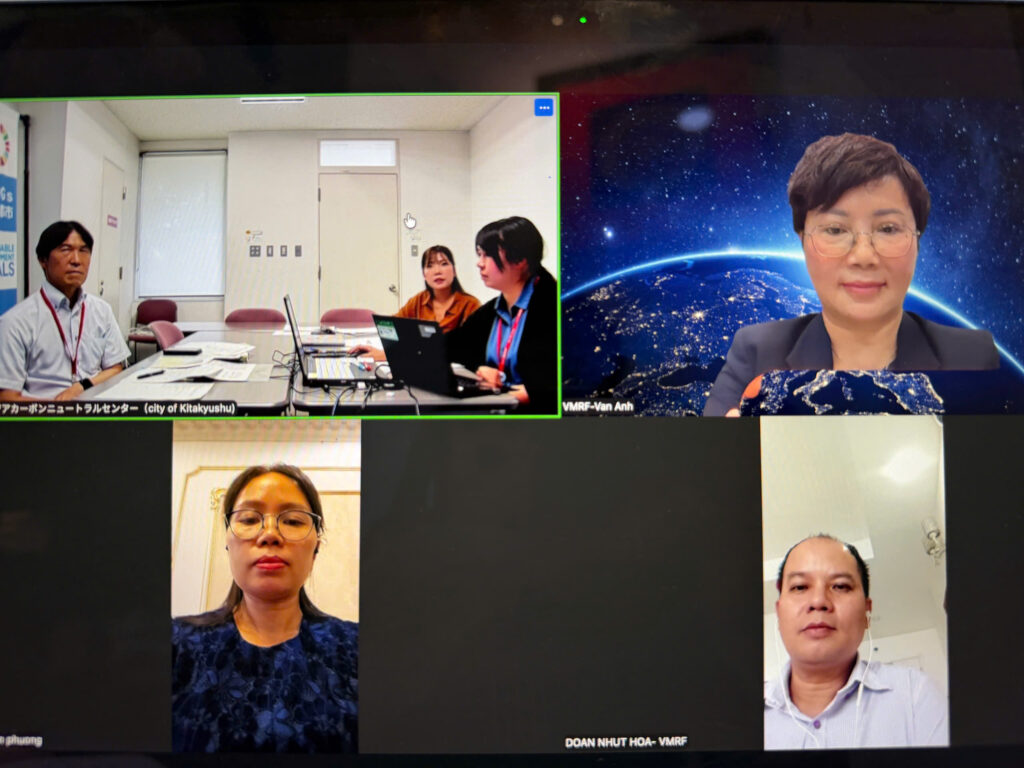
The Vietnam Metal Recycling Forum (VMRF) recently held an online meeting with representatives of the International Environmental Strategy Division of Kitakyushu City, Japan, to discuss potential cooperation in metal recycling, environmental technologies, and the development of a circular economy.
Kitakyushu is one of Japan’s cities with extensive experience in developing environmental industries, particularly through the Eco-Town model, which brings together local government, businesses, technology providers, and recycling systems to promote efficient resource use and reduce waste.
During the meeting, the two sides exchanged information on the current state of the recycling sectors in Vietnam and Japan, with discussions focusing on several issues of growing interest to businesses, including industrial waste collection and treatment, aluminum dross recycling, electronic waste (E-waste), solar panel recycling, and solutions to improve energy efficiency in manufacturing facilities.
From the perspective of the Vietnamese market, VMRF noted that businesses’ needs go beyond simply gaining access to advanced technologies. For a solution to be adopted on a broader scale, it must also be technically effective, economically viable in terms of investment and operating costs, and adaptable to actual production conditions.
Based on the discussion, the two sides initially identified four areas that could be prioritized for cooperation and business connections.
The first is business connectivity and information sharing (Connection). VMRF and Kitakyushu City can serve as connecting points for businesses from both sides to learn more about market needs, production capabilities, technology requirements, and potential areas for cooperation.
The second is materials and scrap (Materials). The two sides will explore opportunities involving raw materials, metal scrap, and other material streams with potential for integration into recycling value chains.
The third is technology (Technology). Japanese solutions for recycling, waste treatment, resource recovery, and energy efficiency can be introduced, discussed, and assessed based on the practical needs and conditions of the Vietnamese market.
The fourth is investment and joint ventures (Investment & Joint Venture). As businesses on both sides gain a deeper understanding of each other and establish a stronger foundation for cooperation, opportunities for investment, joint ventures, and technology transfer could be considered at later stages.
Representatives from Kitakyushu City said that the city currently supports a number of Japanese environmental companies in exploring international cooperation and opportunities to expand into overseas markets. Areas of interest include E-waste recycling, solar panel recycling, electronic circuit board recycling and treatment, as well as energy-efficiency assessment and consulting services for industrial facilities.
These are also areas facing growing demand in Vietnam as the volume of electrical, electronic, and industrial waste continues to increase, while resource recovery, emissions reduction, and energy efficiency are receiving greater attention.
In the immediate term, VMRF and Kitakyushu City agreed to maintain their roles as connecting points and regularly exchange information on businesses, technology needs, and specific business-matching opportunities. Rather than pursuing broad and scattered cooperation, the two sides will focus on opportunities with clearly identified needs, partners, and potential for implementation.
Looking ahead, Kitakyushu City expressed an interest in welcoming VMRF members to visit the city to learn more about local companies and environmental models. Conversely, when business delegations or companies from Kitakyushu visit Vietnam, VMRF is prepared to support connections with suitable businesses, local authorities, and other potential partners.
The meeting marks an initial step in exploring and developing cooperation between VMRF and Kitakyushu City. In the next stage, the focus will be on connecting the right partners with the right needs and gradually turning discussions on technology, materials, and environmental solutions into concrete cooperation opportunities that can be implemented and create value for businesses on both sides.
Related Posts
Low River Levels in Borneo Expose New Weaknesses in Asia’s Energy Supply Chain
Green and Circular Projects May Receive 2% Interest Rate Support
US Company Eyes Vietnam’s Used Batteries as an “Above-Ground Lithium Mine”
CMRA Annual Convention 2026 in Ningbo: Reshaping the Recycled Metals Value Chain in a Changing Global Landscape
IBAAS–VFMSTA 2026: International Forum on Bauxite, Alumina, Aluminium and Critical Minerals in Vietnam
Smart Factories Open a New Competitive Race in the Metals Industry: Companies That Control Energy and Data Will Gain the Edge