

 HOME
HOME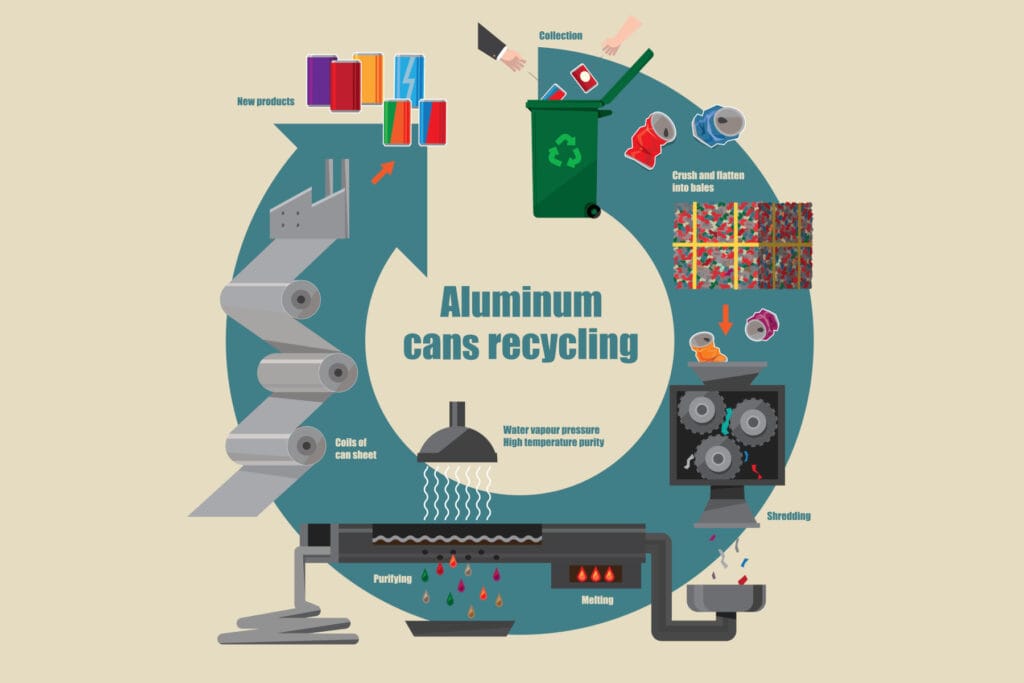
Aluminium has long established its position as one of the most essential non-ferrous metals in the modern industrial economy. Thanks to a perfect combination of lightweight properties, high strength, excellent corrosion resistance, and efficient recyclability, aluminium is widely utilized across various sectors—from construction, transportation, and electrical power to industrial manufacturing and consumer goods. Particularly in the recycling industry, aluminium plays a pivotal role as one of the metals with the most efficient recycling cycles, directly driving the circular economy model and sustainable development.
Overview of Aluminium: Origin and Production
Characterized as a silvery-white metal with low density and high workability, aluminium does not exist in its free metallic form in nature. Instead, it is found within minerals, most notably bauxite ore—the primary raw material for primary aluminium production. Current industrial production typically operates through two key stages: first, refining alumina from bauxite, followed by the electrolysis of alumina to produce metallic aluminium. Alongside this primary stream, secondary aluminium sourced from scrap recycling is increasingly asserting its importance in the global metal supply chain.
Technical Characteristics Shaping Aluminium’s Value
The industrial appeal of aluminium stems from its superior physical and mechanical properties. With a density only about one-third that of steel, aluminium significantly reduces the load for products and structural frameworks. Upon exposure to air, it naturally forms a protective oxide layer on the surface, effectively preventing oxidation and corrosion. In addition to being an excellent conductor of electricity and heat—ideal for power transmission systems and heat exchangers—aluminium is highly versatile in fabrication through rolling, drawing, extrusion, or casting. Most notably, it offers infinite recyclability without significantly degrading its core physical properties.
Alloy Systems and Market Product Forms
In manufacturing, aluminium is often combined with other elements to form alloys that enhance mechanical strength. Common groups include:
- Series 2xxx (Aluminium-Copper): Specialized for aerospace applications.
- Series 3xxx (Aluminium-Manganese): Durable for construction.
- Series 4xxx (Aluminium-Silicon): Used in welding and metallurgical additives.
- Series 5xxx (Aluminium-Magnesium): Outstanding for marine corrosion resistance.
- Series 6xxx (Aluminium-Magnesium-Silicon): The top choice for architectural and industrial extrusion profiles.
- Series 7xxx (Aluminium-Zinc): Offering ultra-high mechanical strength for complex engineering.
This diversity creates a rich supply chain in terms of commercial forms, including high-purity primary aluminium, aluminium alloys, sheets, coils, extrusion profiles, and cast aluminium for automotive components. Specifically, the recycling market is highly active with various scrap classifications such as UBC (Used Beverage Cans), Tense, Taint/Tabor, Twitch, Zorba (after sorting), and various forms of industrial aluminium scrap.
Strategic Role in Key Economic Pillars
Aluminium contributes significantly to the operation of several leading economic sectors. In construction, it is the primary material for doors, curtain walls, and roofing systems. In the transportation industry, aluminium is a key solution for reducing vehicle weight, thereby improving fuel efficiency and reducing emissions. Meanwhile, the power sector relies heavily on aluminium for conductors and high-voltage transmission busbars, while mechanical engineering utilizes the metal for machine components that require a balance of durability and lightness.
Aluminium Recycling: The Engine of the Circular Economy
Aluminium recycling provides dual benefits for both the economy and the environment. Compared to primary production from ore, the recycling process saves significant energy, reduces the demand for natural resource extraction, limits greenhouse gas emissions, and optimizes production costs. It is truly the symbolic material of the circular economy. However, to achieve maximum efficiency, recycling enterprises must focus on strictly controlling the quality of input scrap, applying appropriate smelting technologies, and effectively managing by-products like aluminium dross.
A Strategic Vision for a Green Future
Aluminium has become a strategic material as the world shifts toward a green economy. For the recycling industry in Vietnam, enhancing the understanding of material properties, product classification, and updating new technologies are key factors in boosting competitiveness within regional supply chains. Through the “Industry Knowledge” section, VMRF expects to accompany the business community in building a professional, transparent, and sustainable business ecosystem.
Related Posts
Aluminum Scrap Classification in International Trade
A Practical Guide to Aluminum Scrap Classification in International Trade – 2