

 HOME
HOME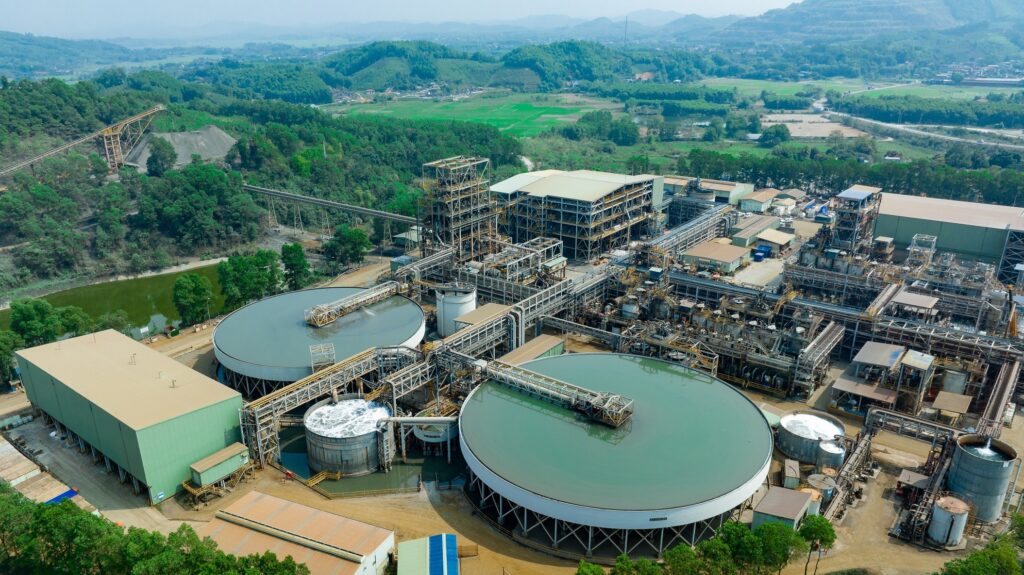
After more than 16 years of investment in the Nui Phao mine and the gradual development of a tungsten value chain, Masan Hightech Materials is entering what could be the most significant turning point in its operating history. Surging tungsten prices, recovering refined output, sharply higher profits and declining debt pressure are opening a new cycle for the company.
Beyond the story of a mining enterprise, the Nui Phao case raises a broader question for Vietnam’s metals industry: Can a large-scale tungsten resource be transformed into high-tech materials manufacturing capacity rather than remaining primarily an extraction asset?
From a polymetallic mine to a tungsten value chain
The core of Masan Hightech Materials’ ecosystem is the Nui Phao mine in Thai Nguyen. The polymetallic deposit contains tungsten alongside several other minerals. It was discovered in 1990, but its reserves were not approved until 2003.
Turning Nui Phao from a long-delayed project into a large-scale industrial mine took years and encountered numerous obstacles, including financing, land clearance and corporate governance issues.
In 2010, Masan Group acquired the project from Dragon Capital. This marked Masan’s formal entry into the mining and resources sector and laid the foundation for Masan Resources, the predecessor of Masan Hightech Materials.
At the time, although the mine had been discovered roughly two decades earlier, only around 2% of the land required for the project had been cleared. To bring Nui Phao into operation, Masan subsequently invested more than US$1 billion in mining, processing and infrastructure.
In 2013, Masan Resources partnered with Germany’s H.C. Starck to develop mineral-processing capabilities. One year later, Nui Phao officially entered the mining and commercial production phase.
This was a critical step because the value of tungsten does not lie solely in run-of-mine ore. Within the metals value chain, greater value can be created through refining, APT production and downstream tungsten products serving industrial applications.
However, just as Nui Phao began operating, the global tungsten market entered a difficult period. Prices fell sharply and remained depressed for years, putting significant pressure on the economics of Masan’s investment.
Why downstream processing became critical
If a mining company focuses only on ore extraction, its financial performance remains highly exposed to commodity prices. When prices fall, margins contract; when prices rise, profitability improves, but the business remains highly cyclical.
For tungsten, the challenge is even more complex. The metal is used in a wide range of strategically important industries, including cutting tools, hard metals, electronics, semiconductors and defense applications.
Masan Resources therefore chose not to stop at mining Nui Phao and continued investing further down the value chain.
In 2018, the company acquired H.C. Starck’s 49% stake in their joint venture, giving Masan full ownership of Nui Phao – H.C.Starck Tungsten Refining Company.
The transaction reduced minority interests and allowed the joint venture’s operations to be fully consolidated into Masan’s financial statements. More importantly, it provided the company with full access to advanced tungsten-processing technologies without continued dependence on future licensing fees.
In 2019, Masan Resources went a step further by acquiring H.C. Starck’s tungsten business platform through a subsidiary. The transaction brought deep-processing lines for APT as well as a portfolio of tungsten-related technologies and intellectual property.
These capabilities included technologies for ultrafine tungsten compounds, spherical tungsten particles and tungsten recovery from electronic waste.
This represented an important strategic shift. Masan was no longer positioning itself simply as a resource producer but was seeking a higher position in the strategic metals value chain.
The company’s name change from Masan Resources to Masan Hightech Materials in 2020 further reflected this ambition.
But the market was not yet ready to reward the investment
The downstream-processing strategy required substantial capital, advanced technology and time to build markets. Meanwhile, tungsten prices remained unfavorable.
Between 2020 and 2022, Masan Hightech Materials’ consolidated net profit ranged from several tens of billions of Vietnamese dong to more than VND200 billion per year, significantly below what might be expected given the scale of investment.
One of the areas expected to generate additional value was tungsten recovery from electronic waste. However, this initiative faced difficulties related to feedstock availability. According to the source material, electronic waste was not included in the list of scrap materials permitted for import and recycling under the Prime Minister’s Decision 13 issued in 2023.
The situation deteriorated further in 2023 and 2024. Masan Hightech Materials recorded annual losses of around VND1.6 trillion as mining costs increased, output declined and higher interest rates placed additional pressure on borrowings.
The company’s challenge at that time was therefore not simply low tungsten prices. It was the combined impact of mining costs, production efficiency and financial leverage.
Divestment of H.C. Starck and the restructuring turning point
At the end of 2024, Masan Hightech Materials completed the sale of its entire 100% stake in H.C. Starck to Mitsubishi.
The one-off after-tax gain from the transaction was used to reduce debt, bringing the company’s total debt down from approximately US$670 million to US$490 million.
Strategically, this represented a significant adjustment.
Rather than continuing to allocate resources across a broad range of activities, Masan Hightech Materials refocused on its core operations centered around Nui Phao.
The divestment did not mean the company completely lost its economic interest in the technology ecosystem it had built. Masan Hightech Materials retained the right to receive part of the economic benefits if H.C. Starck’s black mass recycling technology is commercialized.
This indicates a shift in strategy from expanding the ecosystem at all costs toward optimizing assets, technology and cash flow.
Tungsten emerges as a strategic metal in the supply-chain race
The biggest turning point, however, came from outside the company.
The global tungsten market began changing rapidly in the second half of 2025 as China tightened supply. At the same time, demand from defense, semiconductors and high-tech industries continued to increase.
This is particularly significant for tungsten because global supply is highly concentrated. According to the source material, China accounts for around 80% of global tungsten supply.
That level of concentration is making tungsten increasingly recognized as a strategic mineral, alongside other critical metals that have become central to technological and geopolitical competition.
The United States and Western economies are seeking to diversify supplies of critical raw materials used in defense, semiconductors, electric vehicles and other high-tech industries.
Against this backdrop, a large tungsten mine outside China has implications that extend beyond commercial value to the resilience and security of global supply chains.
APT prices rise more than tenfold, boosting Nui Phao
Market prices have reflected the changing fundamentals.
APT, or ammonium paratungstate, a key intermediate product produced after tungsten ore refining, has risen to around US$3,000/MTU, more than ten times the historical low level cited in the source material.
For a company that has spent years investing in mining and processing capabilities, higher tungsten prices can have a powerful impact on profitability.
According to the assessment cited in the source material, Vietcap Securities expects tungsten prices to remain elevated in the period ahead.
Masan Hightech Materials also believes tungsten demand is relatively price-insensitive. This is important because if demand remains resilient while prices rise, a larger portion of the value generated across the mining and processing chain can translate into profits.
Masan Hightech Materials returned to profitability in the final two quarters of 2025 and set a target of fully repaying its debt during 2027-2028.
The subsequent improvement, however, was faster than expected.
Six months that changed the financial picture
Investments made over nearly two decades are now beginning to demonstrate their value as the market enters an upcycle.
In the second quarter of 2026, the company increased production capacity and lifted refined tungsten output by 91% year on year.
This is particularly important for a mining company. When commodity prices rise, the ability to increase production determines how effectively higher prices can be converted into actual revenue and profits.
As a result, in the first half of 2026, Masan Hightech Materials generated revenue of VND11.13 trillion, up 270% year on year.
Net profit exceeded VND2.2 trillion, compared with a loss of VND216 billion in the same period of 2025.
More significantly, the profit generated in just six months was described as equivalent to the company’s combined profit over roughly its previous 16 years of operations.
This illustrates the leverage inherent in commodity cycles: a system of assets and production capabilities accumulated over many years can generate a dramatic change in cash flow when commodity prices enter a favorable cycle.
From debt pressure to the ability to pay dividends
The transformation is not limited to the income statement.
In August 2026, the Board of Directors of Masan Hightech Materials approved a plan to seek shareholder approval for a 2026 interim cash dividend of 10%, equivalent to VND1,000 per share.
If approved, the company would pay approximately VND1.1 trillion, equivalent to half of its net profit in the first six months of the year.
It would be the first dividend payment by Masan Hightech Materials.
The significance of the move becomes clearer when viewed against the company’s financial history. Just a few years ago, Masan Hightech Materials was dealing with annual losses measured in trillions of dong and debt of hundreds of millions of US dollars.
By the end of the second quarter of 2026, net debt/EBITDA stood at around 2.1 times, a significant improvement supported by the debt-reduction process. The company expects the ratio to continue declining and reach a level better than the planned approximately 1.7 times by year-end.
The current tungsten cycle is therefore doing more than boosting earnings. It is giving the company room to pursue two objectives simultaneously: reduce financial leverage and begin returning profits to shareholders.
Nui Phao expansion: the key to the next growth cycle
If higher tungsten prices are driving the current cycle, additional resources could become the key to the next phase of growth.
Masan Hightech Materials is pursuing an expansion of the Nui Phao project covering nearly 43 hectares adjacent to the existing mine.
The major advantage is the ability to leverage existing infrastructure and operating capabilities. If implementation proceeds smoothly, the company could expand its resource base without having to rebuild the entire operating system from scratch.
According to information released by the company, the mineral exploration proposal for the Nui Phao expansion area is currently under review by the Department of Geology and Minerals.
Another potential resource is the Nui Chiem area, covering approximately 1,000 hectares and estimated to contain around 115 million tonnes of polymetallic tungsten ore.
Nui Phao Mining and Processing, a subsidiary of Masan Hightech Materials, has been identified as eligible for consideration for a mineral exploration license in the area.
If these new resources can be explored, assessed and brought into production while tungsten prices remain elevated, Masan Hightech Materials could have significantly greater growth potential than simply benefiting from the current price cycle.
Vietnam and the challenge of upgrading the strategic-metals value chain
From the perspective of Vietnam’s metals industry, the Nui Phao story matters for more than the profitability of a single company.
Tungsten is a clear example of a broader challenge facing Vietnam’s mining sector: how to move from resource extraction toward downstream processing and participation in the high-tech materials supply chain.
The value of a mine is not determined solely by the number of tonnes of ore that can be extracted. Greater value lies in refining capabilities, technological control, downstream product development and the ability to build stable markets.
Masan Hightech Materials has spent nearly two decades building this chain, from Nui Phao to tungsten refining and downstream processing technologies.
The current price cycle is demonstrating the potential value of that long-term strategy. However, a price upcycle alone cannot automatically create a sustainable competitive advantage.
The company will continue to face risks related to commodity prices, mining costs, ore quality, processing capacity, resource replacement and changes in global trade policies.
As tungsten becomes increasingly strategic, competition will also be determined by more than price. Supply security, processing technology and positioning within global supply chains are likely to become increasingly important.
The big question ahead
After 16 years, Masan Hightech Materials is entering a phase in which long-term investments are beginning to produce tangible results.
Higher tungsten prices, recovering production, stronger profits, lower debt and the proposed first-ever dividend are emerging at the same time. Nui Phao is also approaching a potential expansion of its resource base.
But in the metals industry, every price upcycle comes with a question about sustainability.
Can Masan Hightech Materials use the current period of high tungsten prices to rapidly reduce debt, expand its resource base and increase production capacity? Can Vietnam leverage Nui Phao’s position to strengthen its role in the global tungsten supply chain? And, most importantly, can the company transform its resource advantage into high-tech materials capabilities capable of competing over the long term?
Those questions will ultimately determine whether the current cycle becomes more than a temporary commodity boom for Masan Hightech Materials — and whether Nui Phao can become an important building block in Vietnam’s effort to upgrade its strategic metals and minerals industry.
Related Posts
Copper Hits Record Highs Amid a “Supply Crunch”: AI Is Only Part of the Story
From E-Waste to an “Urban Mine”: Vietnam Faces an Opportunity to Turn Waste into Resources
VIETNAM’S CARBON MARKET: FROM POLICY TO OPPORTUNITIES FOR RECYCLING BUSINESSES
VMRF & CIRCULATE CAPITAL: PARTNERING TO BUILD CAPACITY – UNLOCK OPPORTUNITIES – CONNECT THE FUTURE
Opportunities to Access Green Finance for Recycling and Circular Economy Businesses
VMRF METAL MARKET BULLETIN: NON-FERROUS METAL MARKETS RISE SHARPLY, WITH HIGH VOLATILITY