

 HOME
HOME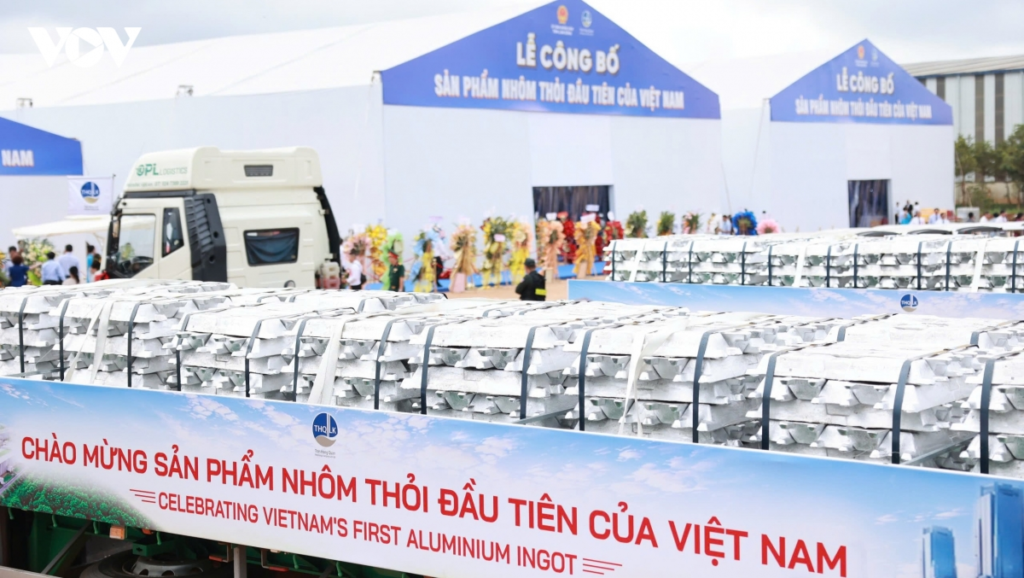
On July 26, Vietnam’s metallurgical industry reached a historic milestone as the country’s first primary aluminum ingots were successfully produced through electrolytic smelting at the Dak Nong Aluminum Smelter in Lam Dong Province. After more than a decade of investment and construction, Vietnam has completed the most critical link in the bauxite – alumina – primary aluminum value chain, joining the small group of nations capable of producing primary aluminum from domestically sourced raw materials.
This achievement is far more than a technological breakthrough. It represents a strategic turning point for Vietnam’s materials industry at a time when aluminum and copper are increasingly recognized as critical minerals shaping the global economy of the future.
From Alumina Exporter to Primary Aluminum Producer
Over the past decade, Vietnam has successfully established a domestic bauxite mining and alumina refining industry in the Central Highlands. However, alumina is only an intermediate product, with the highest value added generated during the electrolytic smelting process that transforms alumina into primary aluminum.
The successful commissioning of the Dak Nong Aluminum Smelter fundamentally changes Vietnam’s position in the global aluminum industry. Rather than exporting alumina as a semi-processed material, Vietnam can now produce primary aluminum domestically, creating new opportunities for downstream manufacturing, including aluminum alloys, rolled products, extrusions, and advanced materials for the automotive, aerospace, electrical, renewable energy, electronics, and defense industries.
The first aluminum ingots produced at the plant achieved a purity of 99.71%, meeting international standards for industrial applications and demonstrating that Vietnamese enterprises are steadily mastering advanced aluminum electrolysis technology.
The first phase of the project is currently operating at an annual capacity of 150,000 tonnes. Upon completion of all three phases in 2027, the plant’s total designed capacity will reach 450,000 tonnes of primary aluminum per year, positioning Vietnam as one of Southeast Asia’s emerging aluminum production hubs.
Aluminum and Copper: The Strategic Metals of the 21st Century
Vietnam’s successful production of primary aluminum comes at a time when global competition for critical minerals is intensifying.
If oil defined the strategic landscape of the 20th century, aluminum and copper are becoming the strategic metals of the 21st century, driven by the global transition toward clean energy, electrification, digital infrastructure, and advanced manufacturing. These metals are indispensable for electric vehicles, battery energy storage systems, power transmission networks, data centers, artificial intelligence infrastructure, solar panels, wind turbines, and the aerospace sector.
As a result, many countries are shifting from relying on international markets to actively securing domestic production capacity and resilient supply chains.
The United States offers a clear example of this trend. Recently, Washington strengthened its trade protection measures by imposing higher Section 232 tariffs on imported aluminum to support domestic smelting capacity. At the same time, the U.S. government introduced policies that reduce import duties on certain materials and provide incentives for companies investing in or expanding aluminum smelting facilities in the United States. This dual approach—protecting domestic production while encouraging new investment—highlights aluminum’s growing importance as a strategic industry for economic security, industrial competitiveness, and national defense.
The United States is not alone. The European Union, China, Canada, Australia, and several Gulf countries are all accelerating investments in both primary aluminum production and aluminum recycling to secure long-term supplies for the green economy.
A Strategic Opportunity for Vietnam
Against this global backdrop, Vietnam’s successful production of primary aluminum carries significance far beyond a single industrial project.
First, it enables the country to capture significantly greater value from its abundant bauxite resources. Rather than exporting alumina, Vietnam can now retain more value within its domestic industrial ecosystem, strengthening trade performance and improving the efficiency of resource utilization.
Second, domestic primary aluminum production enhances supply chain security by reducing dependence on imported metal at a time when global aluminum markets are increasingly influenced by tariffs, geopolitical tensions, and supply disruptions.
A stable domestic supply of primary aluminum will also provide a solid foundation for the development of high-value manufacturing industries, particularly automotive production, precision engineering, electrical and electronic equipment, renewable energy technologies, transportation infrastructure, and defense manufacturing. These sectors are expected to become key pillars of Vietnam’s long-term industrialization strategy.
Furthermore, the presence of a large-scale aluminum smelter is expected to attract significant investment into downstream processing, supporting industries, logistics, and industrial clusters, ultimately creating a fully integrated aluminum value chain instead of one focused primarily on raw material extraction.
Building the Foundation for a Circular Aluminum Economy
From VMRF’s perspective, the greatest significance of this milestone extends beyond the production of Vietnam’s first primary aluminum ingots. It marks the beginning of a fully integrated aluminum ecosystem.
Vietnam’s aluminum value chain can now evolve beyond bauxite, alumina, and primary aluminum to include downstream fabrication, industrial applications, scrap collection, and aluminum recycling, laying the foundation for a circular economy in the aluminum sector.
Aluminum is one of the world’s most sustainable industrial materials because it can be recycled almost indefinitely without losing its inherent properties. With domestic primary aluminum production now established, Vietnam has the opportunity to develop a modern recycling industry that reduces energy consumption, lowers carbon emissions, and strengthens the sustainability of the entire aluminum supply chain.
VMRF Perspective
VMRF believes that Vietnam’s successful production of primary aluminum through electrolytic smelting marks the beginning of a new era for the country’s aluminum industry.
As aluminum and copper become increasingly recognized as strategic metals underpinning the global economy, mastering primary aluminum production technology will enhance Vietnam’s position within international supply chains, attract investment into downstream manufacturing, accelerate the development of advanced materials industries, and support the country’s transition toward a circular economy.
More importantly, this achievement signals a shift from a resource-exporting model to a value-added industrial strategy—one that spans the entire value chain, from bauxite mining and alumina refining to primary aluminum production, downstream manufacturing, and aluminum recycling. By leveraging its natural resources, energy potential, and rapidly expanding market opportunities, Vietnam is well positioned to transform its aluminum industry into one of the country’s future industrial pillars while becoming an increasingly important player in the regional and global aluminum supply chain.
Related Posts
CMRA Annual Convention 2026 in Ningbo: Reshaping the Recycled Metals Value Chain in a Changing Global Landscape
IBAAS–VFMSTA 2026: International Forum on Bauxite, Alumina, Aluminium and Critical Minerals in Vietnam
Smart Factories Open a New Competitive Race in the Metals Industry: Companies That Control Energy and Data Will Gain the Edge
EU Tightens Aluminium Scrap Exports: Global Recycled Aluminium Market Faces a Major Reshaping
Vietnam’s Tungsten Enters a New Cycle: Nui Phao and Vietnam’s Ambition to Elevate Its Strategic Metal Position
Copper Hits Record Highs Amid a “Supply Crunch”: AI Is Only Part of the Story