

 HOME
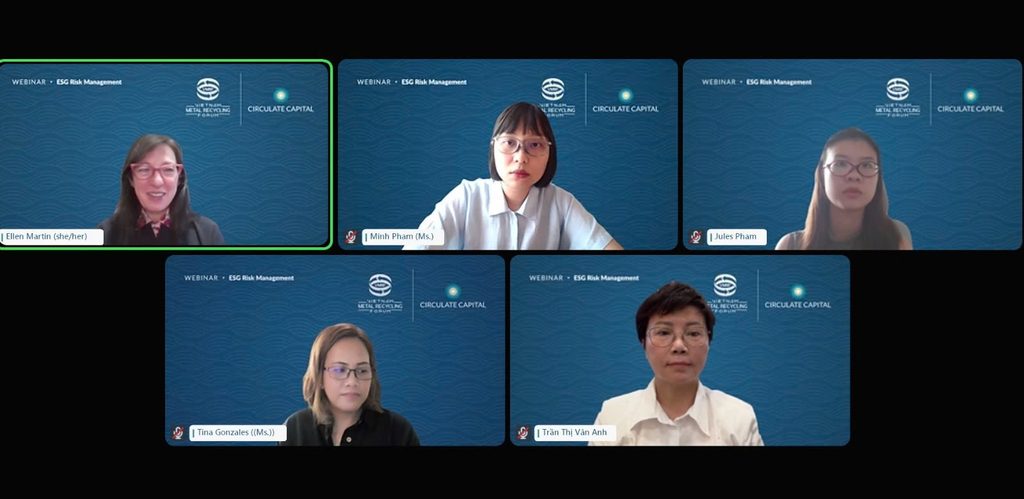
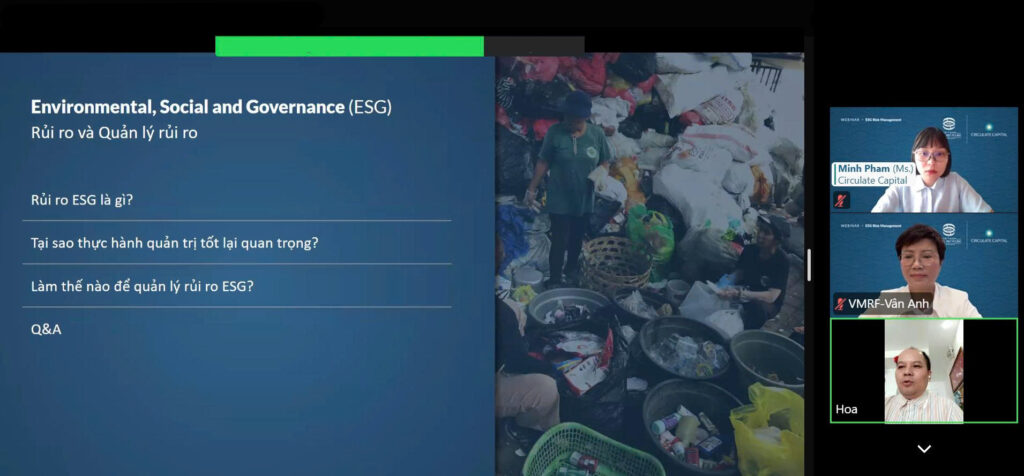
HOMEOn September 30, 2026, the Vietnam Metal Recycling Forum (VMRF), in collaboration with Circulate Capital, organized an online webinar on ESG Risk Management, bringing together businesses involved in metal recycling, scrap collection and trading, metal production, as well as representatives from several financial institutions.
The program focused on practical questions that are increasingly relevant to businesses: How do investors assess ESG? What do businesses need to prepare? And how can ESG contribute to strengthening management capabilities and supporting sustainable business development?
A Significant ESG Gap Remains
A quick survey conducted at the beginning of the webinar showed considerable differences in the level of ESG implementation among participating businesses. Approximately 40% of businesses said they had not yet started implementing ESG, while around 37% were managing individual ESG issues separately. Only a small group had established relatively clear ESG policies or management systems.
The issues attracting the most attention included legal compliance, emissions, wastewater, waste management, occupational safety, traceability, supply chain management, implementation costs, and data collection.
The survey results indicate that most businesses are still at an early stage of their ESG journey. At the same time, the need to strengthen management capabilities, risk control, and data systems to support business operations has become increasingly clear.
ESG Is More Than a Checklist
During the webinar, Circulate Capital emphasized that ESG should not be viewed simply as a checklist of requirements that businesses need to complete in order to meet regulations or partner expectations.
From an investor’s perspective, the issue is not only whether a business has the necessary licenses, procedures, or policies, but also whether it is capable of identifying and managing risks in practice.
Investors want to understand what risks a business is facing, who is responsible for managing them, whether control measures are actually being implemented, and whether the business has data to monitor, evaluate, and continuously improve its performance.
In this context, the PDCA – Plan, Do, Check, Act model was introduced as a practical approach to help businesses move from formal compliance toward building management systems that can operate, monitor performance, and improve continuously.
What Do Investors Want to See?
One of the notable aspects of the webinar was Circulate Capital’s direct perspective on the process of assessing businesses.
In addition to compliance with legal requirements, investors are interested in a company’s ability to identify and prioritize ESG risks, clearly assign responsibilities, manage environmental, health, and occupational safety issues, address labor and human rights concerns, and monitor traceability and accountability throughout the supply chain.
Another key factor highlighted during the discussion was documentation and data demonstrating that the management system is actually operating. Having policies on paper is not sufficient if there is no evidence that these procedures are being implemented and monitored in practice.
Circulate Capital also introduced a self-assessment questionnaire consisting of approximately 20 ESG questions. The tool is designed to help businesses review their level of preparedness across governance, environmental, social, safety, and supply chain dimensions.
ESG Does Not Stop at the Factory Gate
For the metal recycling industry, ESG extends beyond activities taking place within a factory. Issues related to the origin of raw materials, suppliers, working conditions, traceability, and accountability throughout the entire supply chain are also becoming increasingly important.
This is particularly relevant for businesses seeking to participate more deeply in international supply chains or access investment capital. As transparency and supply chain responsibility receive greater attention, the ability to provide data and demonstrate how ESG is managed can become an important part of the business assessment process.
From Awareness to Action
The VMRF – Circulate Capital webinar provided the metal recycling business community with a more practical perspective on ESG: ESG is not only a compliance requirement but also an important component of management capability and sustainable business development.
The survey results showed that nearly three-quarters of participating businesses had either not yet started implementing ESG or were still addressing individual ESG issues separately. This also provides a basis for VMRF to continue developing more specialized programs to support businesses in moving gradually from awareness to action.
The proposed pathway can begin with Understanding ESG → Self-Assessment → Risk Identification → System Development → Measurement and Continuous Improvement, ultimately helping businesses strengthen their ability to access customers, participate in supply chains, and secure financing.
VMRF sincerely thanks Circulate Capital for its partnership and for sharing practical insights with Vietnam’s metal recycling business community.
Some images from the webinar
Related Posts
VMRF and Kitakyushu City Explore Cooperation Opportunities in Recycling and Environmental Technology
Low River Levels in Borneo Expose New Weaknesses in Asia’s Energy Supply Chain
Green and Circular Projects May Receive 2% Interest Rate Support
US Company Eyes Vietnam’s Used Batteries as an “Above-Ground Lithium Mine”
CMRA Annual Convention 2026 in Ningbo: Reshaping the Recycled Metals Value Chain in a Changing Global Landscape
IBAAS–VFMSTA 2026: International Forum on Bauxite, Alumina, Aluminium and Critical Minerals in Vietnam